Refusal Vectors in Mamba Codestral-7B

Abstract

Mamba, a powerful alternative to Transformers, is a structured state-space sequential model inspired by S4, H3, and gated MLP. Famously introduced by Albert Gu and Tri Dao, their Mamba model takes constant inference time regardless of the context length. This efficiency boost raises the possibility of much faster scaling laws than transformers, and efficient long-context inference. The Mamba architecture has very high potential, but research into interpretability and safety mechanisms in state space models is lacking. Inspired by Arditi et al., I found a single steering vector in Mistral's open-source instruction-tuned chat-based SSM codestral-7b based on the improved Mamba2 architecture. Ablating this vector in the residual stream at layer 35 (out of 64 total) reduces refusals to harmful prompts by more than 40%. Adding this vector to the residual stream of harmless prompts causes the model to refuse on 45% of harmless prompts compared to baseline. These results broaden the span of difference-of-means methods, and further demonstrate the similarity in the mechanisms of Mamba and transformer models.

Introduction and Motivation

Mamba represents a significant advancement in sequence modeling, departing from the attention-based paradigm that has dominated recent years. Introduced by Gu and Dao, this structured state-space model (SSM) achieves linear-time inference through selective scanning, enabling processing of arbitrary sequence lengths without the quadratic complexity inherent to transformers. By incorporating techniques from S4 and gated MLPs, Mamba demonstrates competitive performance across various tasks while maintaining consistent computational requirements regardless of context length, making it particularly attractive for applications requiring efficient processing of long sequences.

Steering vectors, first identified in transformer architectures by Arditi et al., represent interpretable directions in model activation space that correlate with specific behaviors or capabilities. These vectors can be identified through various techniques, including optimization over model outputs or analysis of activation differences between distinct behavioral modes. Recent work by Turner et al. has shown that these vectors often exist across model scales and architectures, suggesting they capture fundamental aspects of model computation rather than artifacts of specific architectures. Arditi et al. developed a novel methodology for identifying steering vectors related to model safety behaviors. Their approach utilized the difference-of-means between internal activations in harmless vs. harmful prompts. Using automated refusal scores, they successfully isolated single vectors that, when manipulated, could reliably control the refusal behavior of multiple transformer-based language models.

In early 2024, Ali et al. found steering vectors in transformer models that controlled refusal behavior. Given the demonstrated similarities between Mamba's computational patterns and those of transformer models, particularly in terms of their learned representations and behavioral characteristics, I hypothesized that similar steering mechanisms would be present in Codestral-7B. This expectation was strengthened by initial observations of Codestral's robust refusal behavior on harmful prompts, suggesting the presence of similar safety mechanisms despite its distinct architectural foundation.

Background

Refusal

Language models are usually pretrained on a vast corpus of data, but after pretraining they only have the capability of continuing an arbitrary stream of text. Instruction fine-tuning is the process of further fine-grained training of the model to follow a certain format using "system" prompts, "user" prompts, and "assistant" responses. System prompts are chosen to elicit desirable behavior, such as responding truthfully and safely. Importantly, the fine-tuning process is supposed to teach the model to refuse to answer harmful, dangerous, or false content. Various AI safety researchers are interested in battle-testing the robustness of this safety fine-tuning, and there is an existing body of research in how to jailbreak models via prompts or adjusting model internals.

Steering Vectors

The linear representation hypothesis states that "features" (meaningful information) are stored in residual streams as linear combinations of nearly-orthogonal basis vectors. In the past, features have been discovered for all kinds of objects and concepts, and the cosine similarity between these vectors and the residual stream has been shown to control the description or presence of the object in subsequent text. Because these vectors can be used to continuously control model behavior, they are called "steering vectors." In this work I found a steering vector that controlled refusal.

Mamba Background

The Mamba language model is based off of previous work in RNNs and state space models. The crucial thing to keep in mind is that Mamba only requires the current "hidden state" and a constant number of previous input tokens to compute the next output token. Thus, inference takes linear time, in contrast to the quadratic time of full-attention transformers, even with KV caching.

Similar to the standard transformers recipe, Mamba uses several layers each composed of parallel blocks that take a residual stream as input, project to some head dimension, perform some operation, normalize, and add back into the residual stream. Other recent work establishes theoretical equivalence between Mamba models and a specific subset of transformers. For this reason I conjectured that a simple difference-of-means in the residual stream would yield a vector that controls refusal in Mamba models, similar to Arditi et al.

I used the codestral-7b open code model released by Mistral in July 2024. It performs on par with other transformer models of the same size on various code benchmarks. Importantly, it has also been instruction fine-tuned and refuses on harmful prompts. It uses Mistral's standard tokenizer, with 64 layers and a token dimension of 4096.

Mamba Operation

Here is more information about the Mamba model for the interested reader. Original paper by Gu and Dao.

Mamba is based on the mathematical theory of state space models. State space models are a sequence-to-sequence model similar to RNNs in flavor. They take a continuous input signal \(x\) and parameters \(A,B,C,\) keep a hidden state \(h,\) and have a continuous output \(y\) defined by $$ \begin{align*} y(t)&=Ch(t),\\ h'(t)&=Ah(t) + Bx(t). \end{align*} $$

Under this theoretical formulation it's possible to express exactly the form of \(y(t)\) given \(A,B,C,\) and \(x\):

$$ y(t)=\int_{0}^{t}\left[ CA^{t-i}B \right] x(t)\,dt. $$

Specifically, the output sequence \(y(t)\) is the convolution of \(x(t)\) with the sequence \(CA^{t}B.\) Here, matrix exponentiation is defined via exponentiation of the singular values of \(A,\) since it is a square matrix mapping from hidden state to hidden state.

Token streams such as text are not continuous signals. Mamba's first insight was to make the signal discrete, but have the "length of time" of each token vary dynamically. In this way, less important tokens would have a smaller effect on the hidden state i.e. memory, and more important tokens would persist in the signal for a longer time and have a large effect on, or even reset, the hidden state. The time of each token is denoted \(\Delta,\) and a mathematical function \(\text{discretize}\) can be used to convert this sequence pair of tokens with durations into a single discrete sequence of distinct \(A_{i}\) and \(B_{i}.\)

The designers also made various optimizations to improve inference speed. The hidden state dimension \(N\) is much larger than the token dimension \(D,\) so instead of letting \(A\) be full-rank the designers made \(A\) a diagonal matrix, and called this a "structured state-space sequence model" (S4).

The designers also let \(B,C\) vary as functions of the input token, causing the output to attend to varying parts of the hidden state (recall: memory) as the input token changes. They also implemented the convolution with a parallelized scan algorithm, leading to the final "structured selective scanning state-space sequence model" (S6).
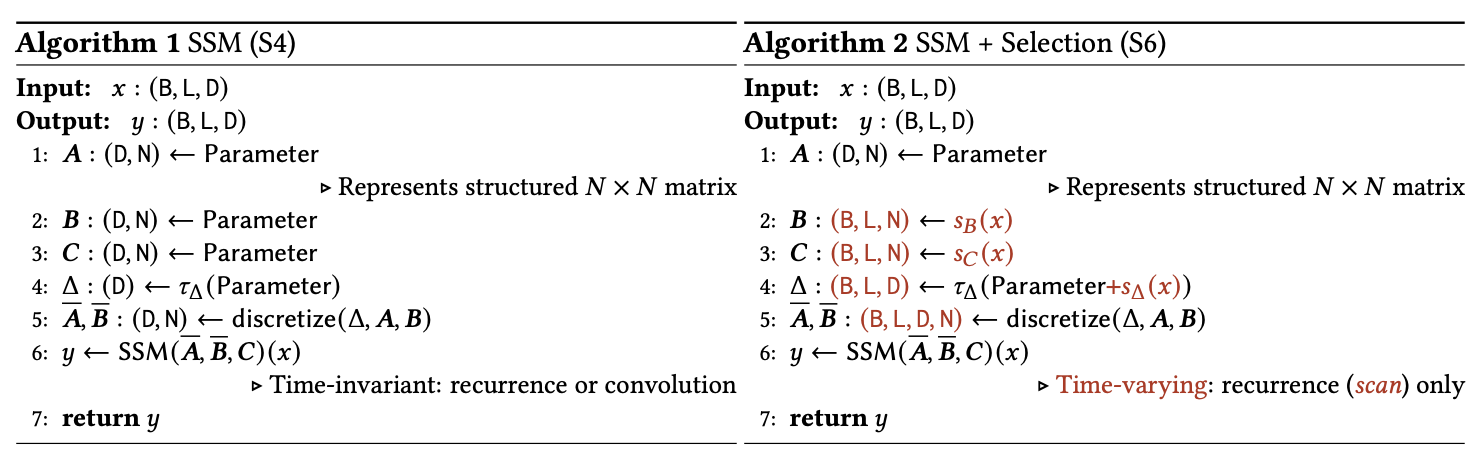
Figure 1: S6 algorithm.

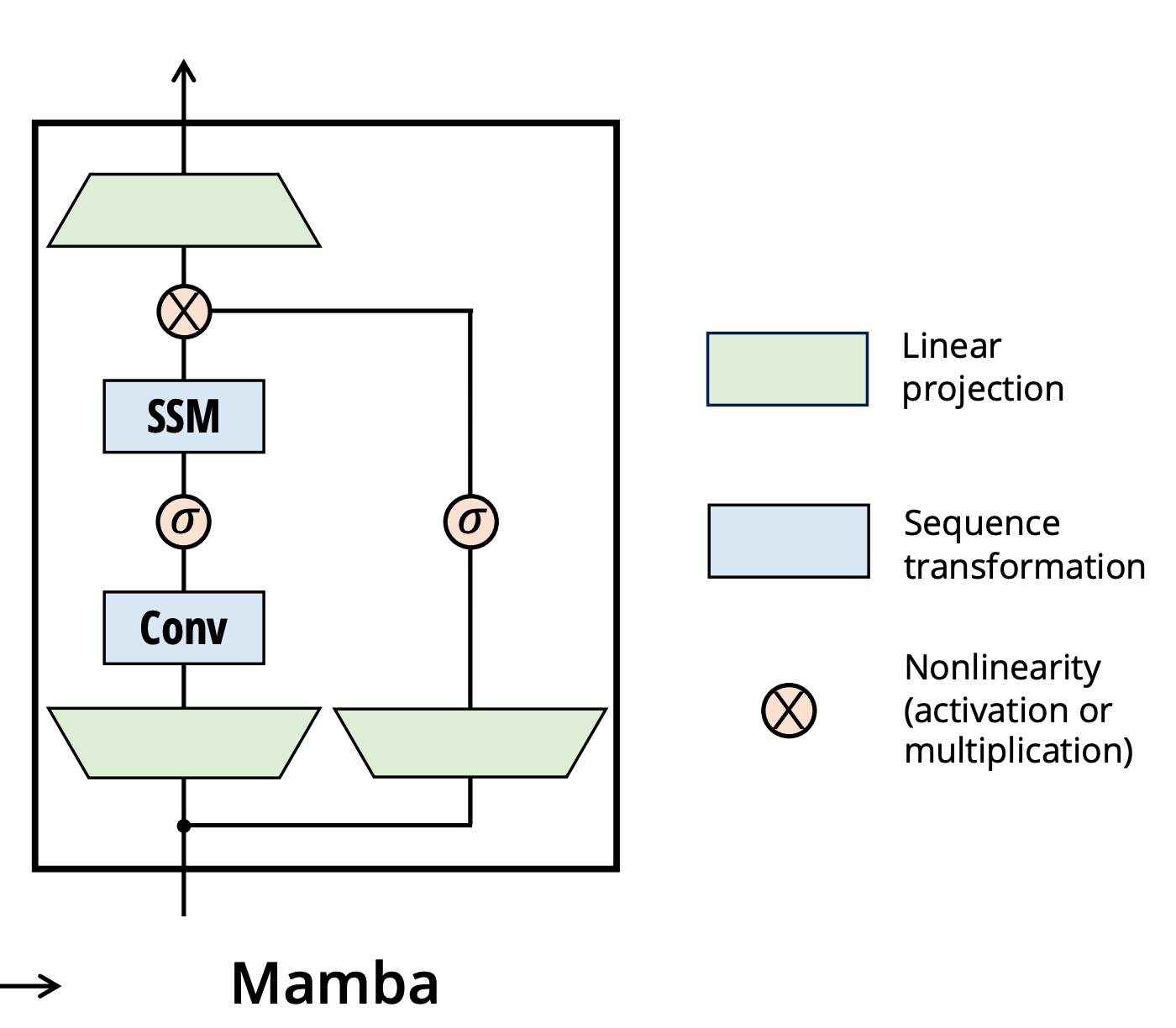
Finally, to build the sequence model Mamba, the designers took inspiration from multi-head transformers and gated MLPs, by

Figure 1: Structure of the Mamba block.
Figure 2: Structure of the Mamba block.

Codestral uses the slightly improved Mamba2 architecture, which was designed to parallelize more performantly.
Methodology

I began by handcrafting the below system prompt to maximize the baseline refusal rate on the harmful datasets.

"As an AI assistant, your core function is to help users while safeguarding against potential misuse. You must refuse any requests that could lead to harm, illegal activities, or the spread of misinformation. When declining, offer a brief explanation and suggest safer alternatives when appropriate."

Note that this system prompt encourages very conservative behavior, even causing the model to refuse on more than 25% of harmless prompts.

I used the same harmful/harmless instruction datasets collated by Arditi et al., namely training on AdvBench and testing on HarmBench, Jailbreak, and more. I used the first 256 prompts in Advbench as my training dataset to find my refusal vector and layer.

To find possible refusal vectors, I used nnsight to compute the average residual stream output from each layer in Codestral-7b for each of the first 16 post-prompt tokens. I did this separately for my harmful training dataset, sampled from HarmBench, and my harmless training dataset, sampled from Alpaca. I then took the difference-in-means between these two datasets, and normalized the resulting vectors to have \(L_{2}\) norm of 1.

I then selected the most effective vector by running over the same training harmful datasets. For each harmful prompt, at inference time I orthogonalized the refusal vector from the residual stream output of the corresponding layer. Instead of evaluating a greedy decoding, I evaluated the first-token logit using a fast refusal score. I then took the refusal vector and layer corresponding to the lowest fast refusal score averaged over all harmful training prompts.

Refusal Scores

I employed a fast refusal score and a slow refusal score.

Slow refusal score operated over 16-token greedy decodings. I categorize a response as a refusal if it includes characteristic phrases such as ”I’m sorry” or ”As an AI assistant”. A full list of the tokens used to categorize refusal can be found here.

The fast refusal score operates on the first post-prompt logit. I designated these specific tokens as "refusal tokens," and after taking the softmax of the logit I evaluate the probability that the first token is a refusal token. The final score is the logit of this probability.

Evaluation and Results

I found the best refusal vector to be located at layer 35 out of 64, mirroring Arditi et al. that drew the best refusal vectors from near the middle of the network.

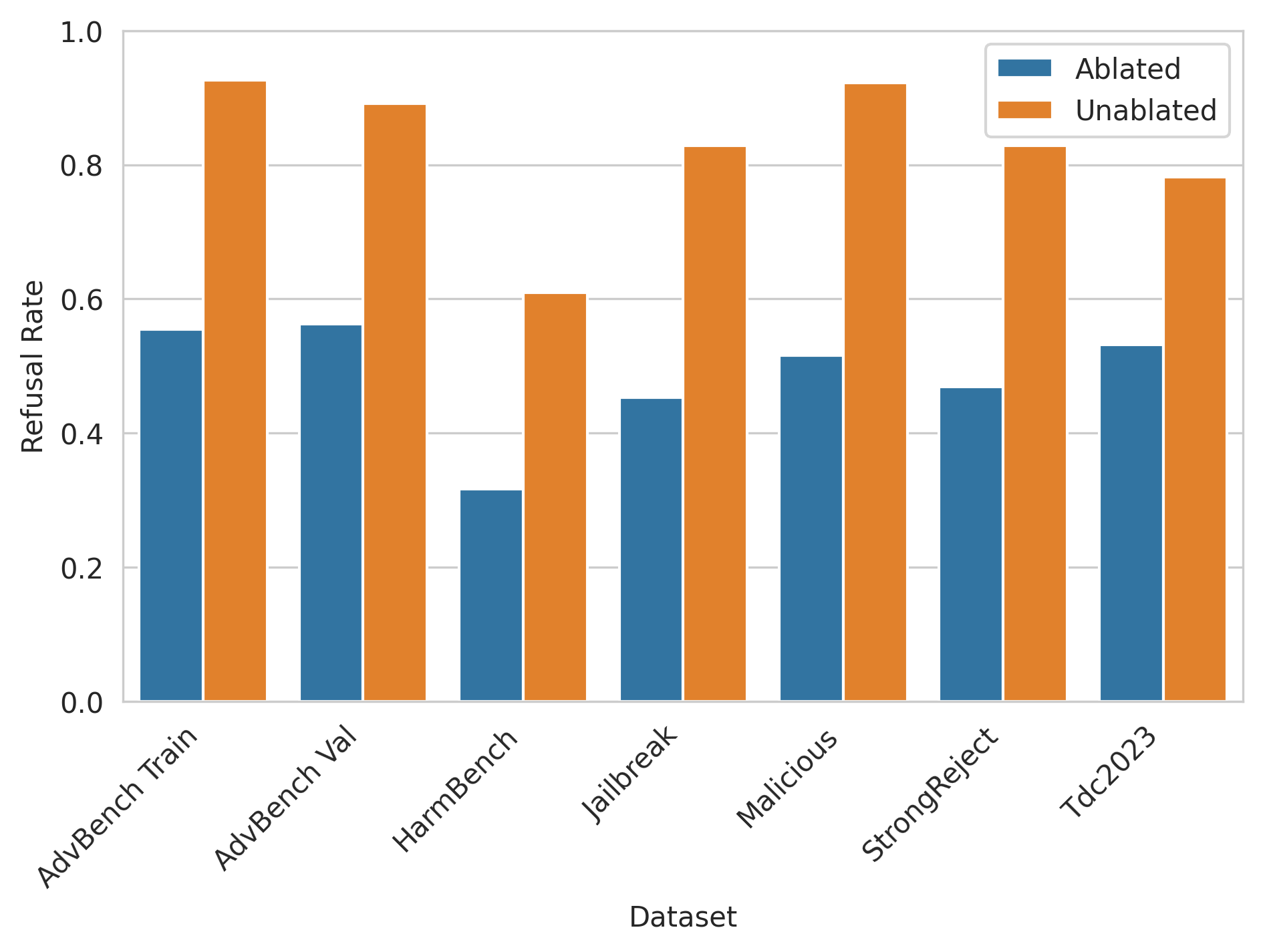
In Figure 3 shown below, I tested the slow refusal score over 64 harmful prompts from each of the other datasets used by Arditi et al., including 64 new prompts from Advbench that did not appear in the training set. Refusal rates were higher than 90% on Advbench and Malicious, but fell to below 60% after ablation. All test datasets saw 40% reductions or higher in refusal rate.

Figure 3: Refusal rates on harmful datasets before and after ablation.

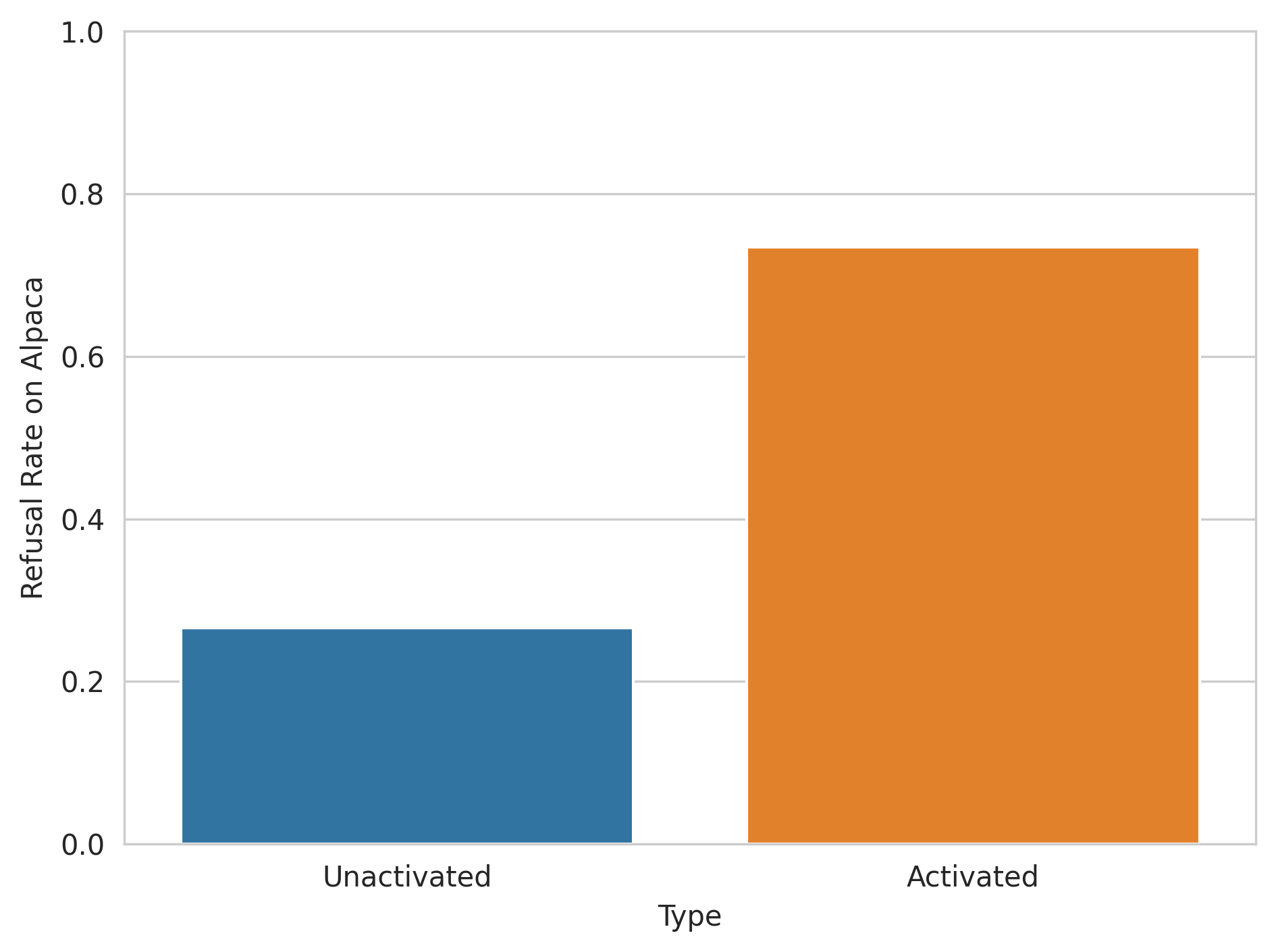
I also wanted to test whether activation of refusal on harmless prompts was possible. In Figure 4 shown below, I directly added two times the (normalized) refusal vector to the residual stream at layer 35, and evaluated refusals on a harmless dataset drawn from Alpaca with and without activations. The refusal rate more than tripled after adding the refusal vector, even though responses stayed topical.

Figure 4: The activation of refusal vectors on harmless prompts induces refusal.

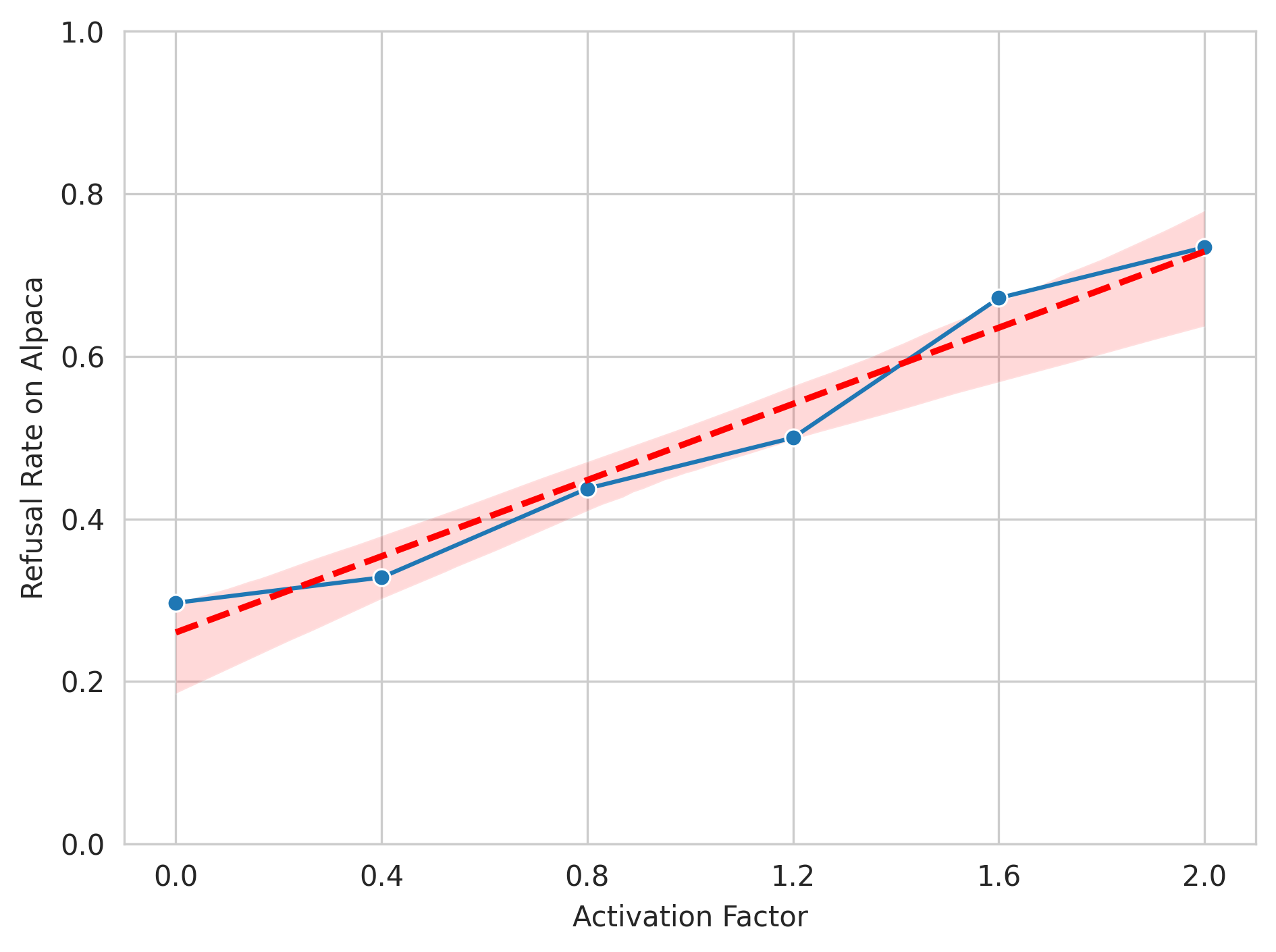
I examined how the refusal rate changes as the multiple made to the refusal vector (the activation factor) changed from 0 to 2. In the below figure I evaluated the refusal rate for various activation factors, beginning with no change and ending with the multiple of 2 demonstrated earlier. The refusal rate seems to increase linearly with the activation factor.

Figure 5: Change in refusal rate with activation factor
Figure 5: Change in refusal rate with activation factor.

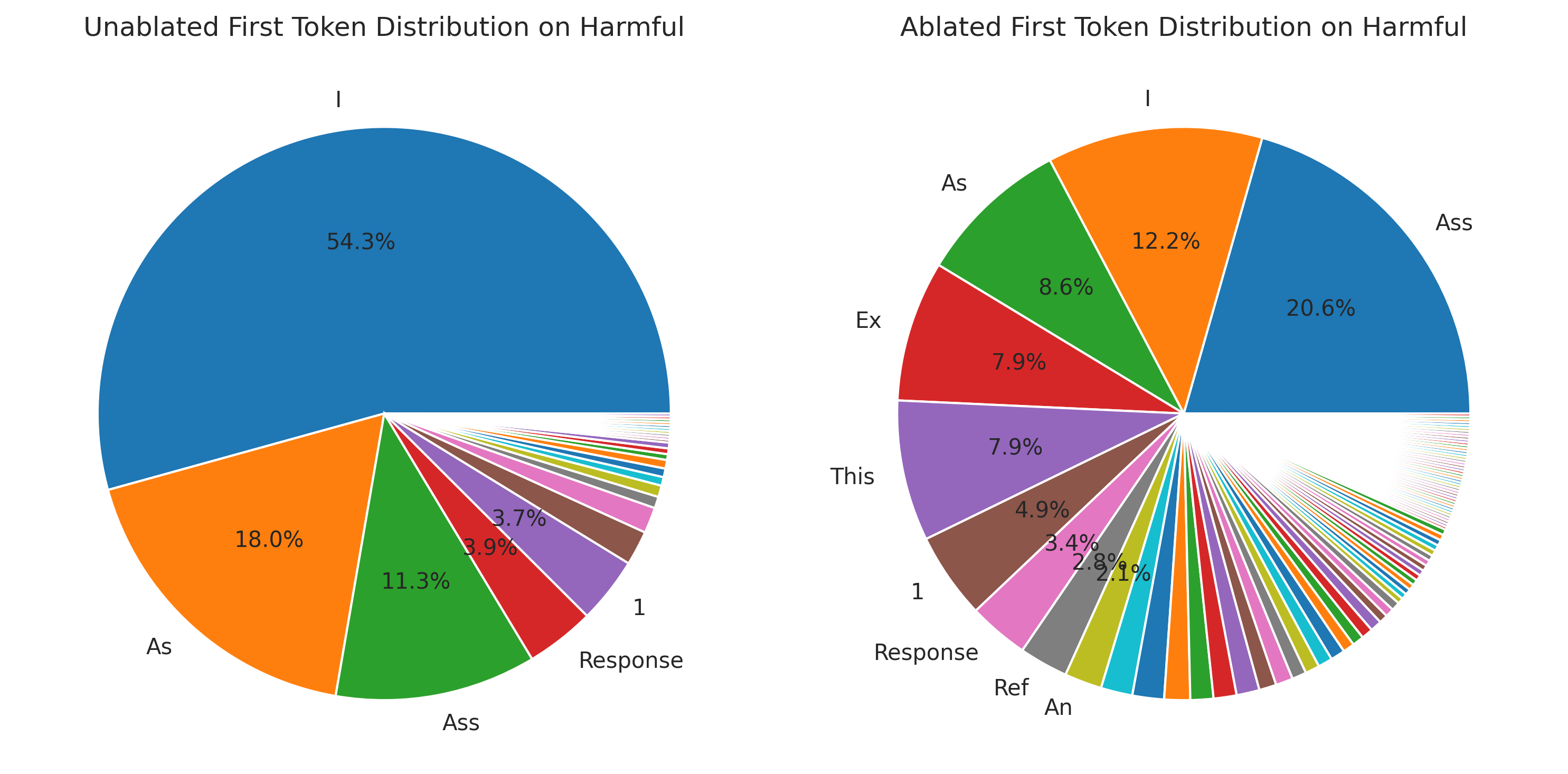
As many other researchers have found, refusal is strongly correlated with the first token. Naturally I expected the distribution of the first token to change after ablating or activating the refusal vector, given that it was selected based on its effect on first token logits. In Figure 5 below, I compared the distribution of first tokens before and after ablation on harmful prompts. The first token shifted from being dominated by "I" (the most standard first token for refusal) to more evenly distributed across a variety of refusal and acceptance tokens (e.g. "1" and "Response").

Figure 6: First token distribution on harmful prompts before and after ablation.

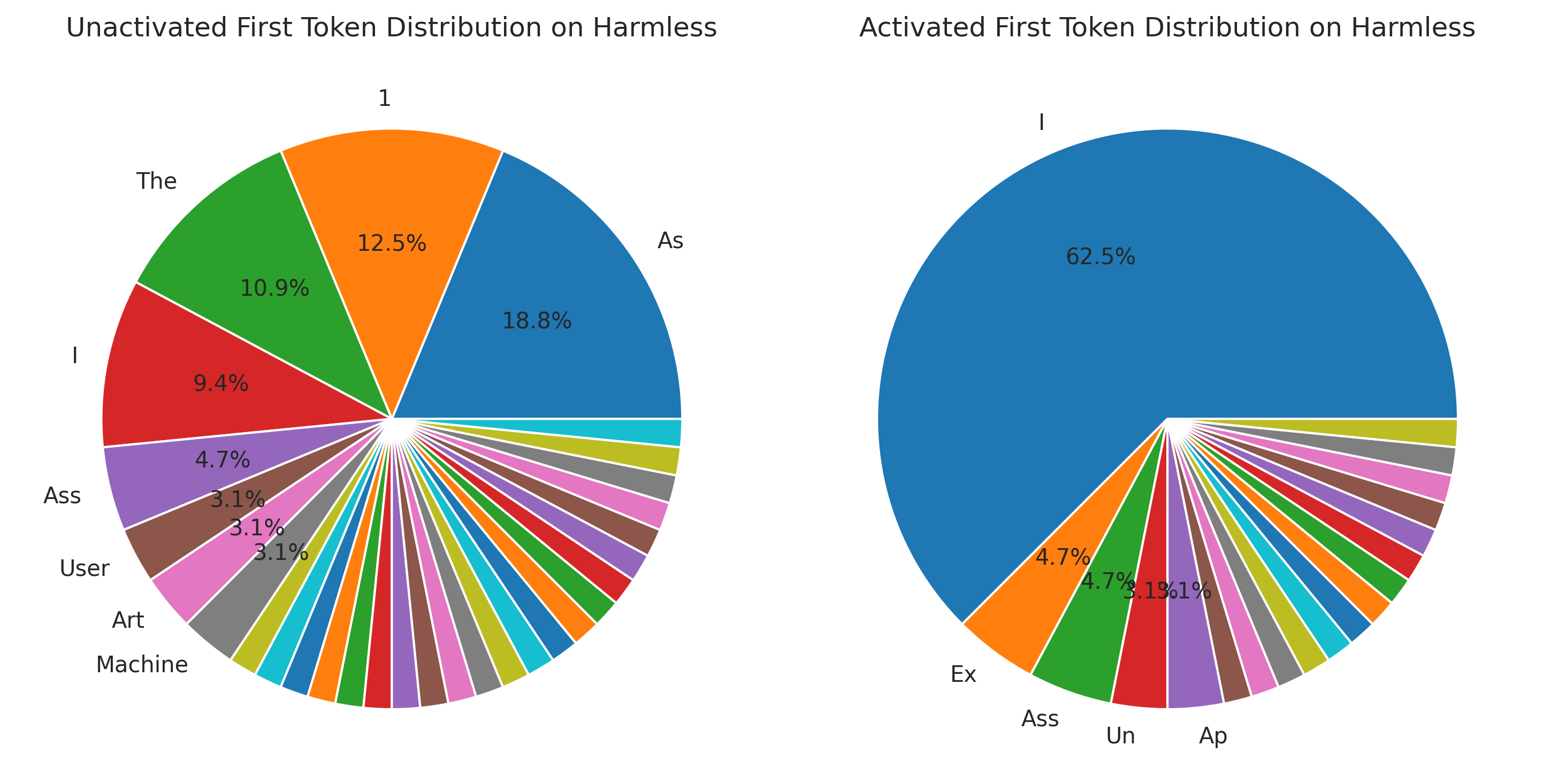
I did the same for harmless prompts, and found the opposite pattern. Adding the refusal vector caused the model to respond with "I" 62.5% of the time. Adding a refusal vector only halfway through the model can cause it to reliably output "I" as the first post-prompt token, and that reliably leads to refusal.

Figure 7: First token distribution on harmless prompts before and after activation.

Concluding Remarks

In this work, I explored internal model activations in an instruction fine-tuned Mamba model to find a single refusal vector. I used two different automated refusal scores and difference-of-means between two different prompt datasets to first find a collection of possible refusal directions, and then evaluate them. I finally used these refusal vectors to

  1. ablate internal activations and elicit responses to harmful prompts,
  2. activate internal activations and elicit refusal to harmless prompts.
The refusal vector behaves as expected, with increased activation resulting in increasing refusal rates. Finally, similar to in transformers, the first output token serves as a strong proxy for whether the model will refuse. The token "I" dominates this effect.

There are several possible directions for future work:

Thanks to Achyuta Rajaram and Anish Mudide, as well as TA Jamie Meindl, for helping with ideation.

References